
International drum finishing (55 Gal)

Let’s talk about your project

Vertical exterior finishing & reconstruction drum lining with Airmix®

Best finishing mileage and ROI, save paint with efficient color change, thermal control, operator-friendly, and easy servicing solution.

Discover our solution

This high-pressure multi-color Airmix® solution enables automated tri-tone drum coating with fixed guns and precise color control at each station ensuring flexibility, efficiency, and clean transitions between production batches.

Paints of different colors are agitated inside their delivery drums, heated, and circulated to the different stations at high pressure. All paints are ready for use at each station, thanks to a color-change valve, upstream filter, and regulator.

In the stations, a stop-and-go conveyor brings the drums one by one in front of a collection of fixed Airmix® guns. Once in position, the drum rotates on itself and the guns spray. Guns can be fed by different colors to achieve three-tone coating—like red at the top, blue in the middle, and green at the bottom.

Finally, when it's time to change color or stop production, a dumping line collects the wasted paint and rinsing solvent.

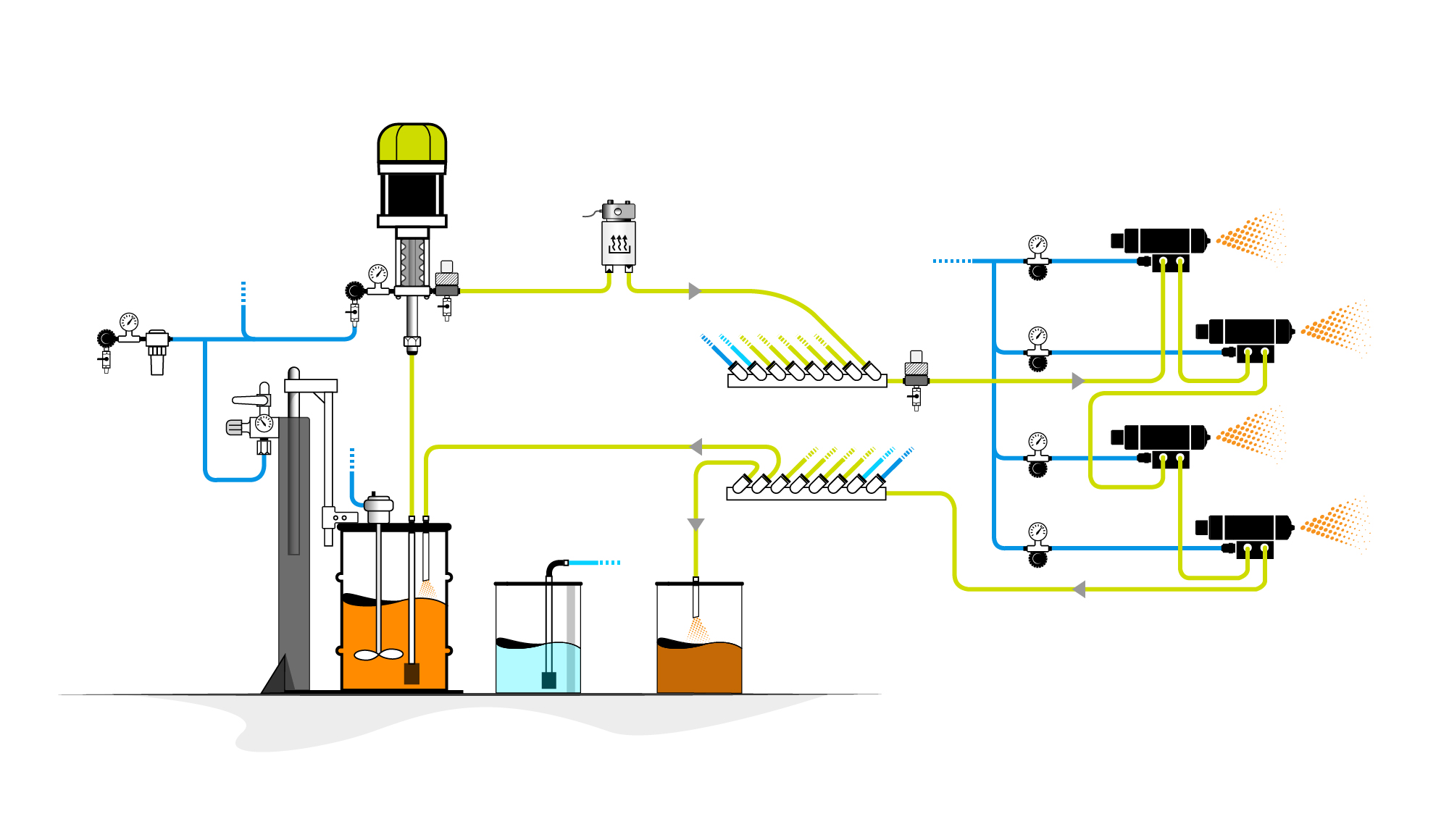
Interactive diagram for information purposes

Main benefits

Achieve the highest coating quality with advanced paint conditioning, precise thermal control, and Airmix® spraying technology

Efficient color change process with zero downtime and minimal paint and solvent waste

Unlimited color combination for each batch with no process limitations

Quick return on investment, thanks to the optimized paint circulation system design and the use of Airmix® spraying technology

International drum finishing (55 Gal) solution FAQ

Let's get in touch
  • Do I need to have masking operation in order to make bi or tri-tone coating?

    For this type of product, you can take advantage of their geometry by choosing an edge or a bump as a border between 2 areas of different colors, this trick will make the demarcation between colors clearer. It is remarkable that Arimix or Airless technologies offer sufficiently clear edge impacts with respect to customer requirements. In the case of stronger requirements only, a masking process will then be considered.

  • How to choose between powder or liquid coating process?

    Powder coating is almost always the best choice except in the 80% of cases where it isn’t. Joking aside, while powder offers many advantages, liquid coatings remain essential for specific and demanding applications.
    More details:
    Powder coating is often favored for its excellent transfer efficiency, durability, environmental friendliness (low VOC), and cost-effectiveness. It’s a go-to solution when sustainability and robustness matter most.
    That said, liquid coatings are still the best (and sometimes the only) option when:
    - Parts are non-metallic (like plastic or composites) and can’t be cured in an oven.
    - Large or heavy parts make high-temperature curing too energy-consuming.
    - High-end aesthetic finishes are required (extreme gloss, mirror-like smoothness, etc.).
    - Fast color changes are needed, as in custom or small batch production.
    - Specialty coatings are used (like PVDF or functional layers).
    - Heat-sensitive components (electronics, seals) are part of the assembly.
    - Critical mechanical tolerances don’t allow any thermal expansion or stress.
    At Sames, we provide cutting-edge equipment and expertise for both powder and liquid coating solutions. We’re here to guide you to the best choice for your parts, your process, and your performance targets
  • Why should I heat my paint?

    Heating your paint might sound like a luxury but it’s actually a smart move for stability, quality, and even equipment optimization. And when you go above 40°C, you not only treat your paint, you beat the seasons!
    More details:
    Heating paint brings several key benefits to industrial coating processes:
    - Stable performance all year round: Above 40°C, your paint is no longer affected by seasonal temperature swings from winter chill to summer heat. You gain consistent viscosity, paint flow and behavior, batch after batch. Specially if you set-up your paint flow with a pressure regulator, keep in mind that temperature change means pressure change and so paint flow change.
    - Lower viscosity = lower pressure: Heating naturally reduces paint viscosity. This leads to:
    - Smoother flow through circuits, even over long distances
    - Reduced pressure losses
    - Downsized, less energy-consuming pumps
    And sometimes, the ability to switch from high-pressure to medium-pressure spray systems, such as Airmix®, which might not be feasible with cold, viscous paint.
    Just be cautious some paints are heat-sensitive and should be handled with care. At Sames, we help you define and implement the right thermal strategy with heated tanks, hoses, regulators, and complete temperature-controlled paint kitchens
  • Is this solution of drum coating already implemented at industrial scale?

    Yes, our drum coating solution for 55-gallon (international standard) drums is already in use at multiple industrial sites worldwide, including for bi-tone and tri-tone applications. It’s a mature and reliable process.
    If you have a specific need or project in mind, feel free to contact us,  we’ll be happy to support you

Still have questions?

Let’s talk - our experts are just a message away.

Let's get in touch