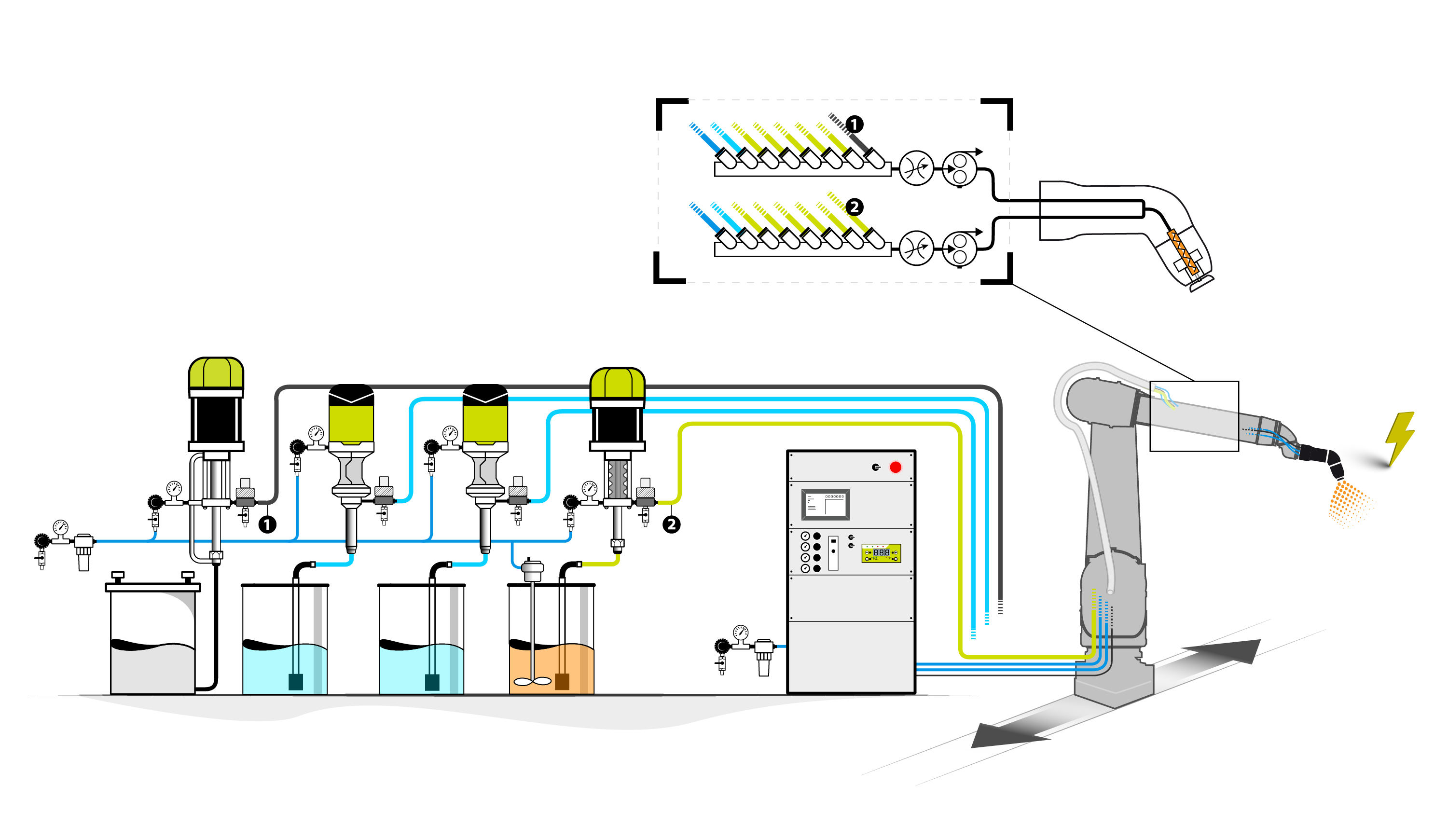
Robotic coating of rail car
Let’s talk about your projectSpray 2K SB (solventborne) primer & topcoat with robotic electrostatic bell
Automate, save up to 50% of paint, 30% of cycle time and obtain better finishing quality with Sames Nanocoat robotic electrostatic rotary bell spraying combined with a process arm 2K antenna embedded onto the robot.
Description
The entire hardener circulation system is fully sealed to prevent moisture exposure. When spraying is triggered, the selected color and hardener are released from the Upside color-change block.
The robot operates in sync with up to two external axes, creating a 8-axis robotic system capable of reaching nearly all rail car surfaces. A final manual touch-up is performed if necessary.
Interactive diagram for information purposes
Related products
Main benefits
Productivity: Automate your coating process and achieve over a 30% increase in production capacity.
Efficiency: Achieve up to 50% savings in paint compared to non-electrostatic conventional coating technologies.
Coating Quality: Achieve uniform coating thickness and superior coverage, thanks to Sames’ advanced electrostatic technology.
Flexible Solutions: Select from integration packages offered without control, with optional control systems, or as a complete turnkey solution for end customers.
Robotic painting process of rail car solution FAQ
Let's get in touch-
What support does Sames offer to assist in selecting the right equipment for my needs?
Consultation Services: Sames provides expert consultations to understand your specific requirements and recommend suitable solutions.Comprehensive Product Guides: Access detailed product guides and selection tools to assist in making informed decisions.Global Presence: With a strong international presence, Sames can quickly respond to emerging market needs by developing innovative equipment.Leveraging these resources ensures that you select equipment tailored to your operational demands. -
How can a robot manage to access such a large part like a railcar?
A 6-axis robot, mounted on additional 7th and 8th linear axes, moves along the length and height of the railcar. These extra axes are fully synchronized, ensuring precise and efficient coating of even the largest surfaces. With deep expertise in complex robotic kinematics, Sames delivers advanced solutions for seamless automation in railway coating.More details:Coating a railcar requires access to extensive and complex surfaces, including side panels, roofs, and undercarriages. To achieve this, a 6-axis robot is installed on a 7th-axis rail system, moving it front-to-rear along the railcar’s length. An optional additional 8th-axis provides vertical movement for bottom-to-top coverage.Sames and Sames’partner deep experience in multi-axis robotic kinematics allows for perfect synchronization between these external axes and the robot’s internal 6 axes. This ensures smooth, continuous spraying with optimized coverage, reduced cycle time, and minimal material waste.With decades of expertise in multi-axis robotic solutions, Sames and its integrator partners enables full automation for railway coating, ensuring high-quality finishes, process consistency, and maximum efficiency. -
Why choose a 2K rotary bell, such as the PPH 707, for railway coating applications?
The PPH 707 SB-2K rotary bell delivers high productivity (up to 800 cc/min), superior finish quality, and reduced material waste. Its electrostatic efficiency and symmetrical round spray pattern simplify robotic trajectories, making it far more efficient than spray guns for coating large surfaces like railcars.More details:The PPH 707 rotary bell is designed for high-speed, high-efficiency 2K paint application. Unlike spray guns, which require complex multi-angle trajectories, the PPH 707's round spray pattern is perfectly symmetrical relative to the robot's 6th axis, allowing for simpler, faster motion paths. This reduces cycle times while maintaining consistent coverage across large railway components.With a flow rate of up to 800cc/min, the PPH 707 is one of the most productive solutions available, capable of handling high-output applications with minimal overspray thanks to optimized electrostatic transfer efficiency. Additionally, the 2K mixing occurs just before spraying, preventing material waste and ensuring a fresh, homogeneous coating at all times.This combination of speed, precision, and material savings makes the PPH 707 rotary bell the ideal solution for railway manufacturers seeking optimized robotic painting performance. -
Can the same robot spray both epoxy primer and PU topcoat?
It is strongly not recommended to use the same fluid circuit for both epoxy primer and PU topcoat due to their chemically incompatible hardeners, which can lead to severe quality issues. However, alternative solutions exist depending on the application constraints.More details:Epoxy and polyurethane (PU) hardeners react aggressively when mixed, making it highly problematic to use the same paint circuit, even with thorough flushing sequences. This can cause cross-contamination, poor coating quality, and major maintenance issues.There are two possible solutions to manage this challenge:Using two completely independent premixed supply circuits: This allows each coating to remain separate and avoid contamination. The PPH 707 SB rotary bell can accommodate two circuits, but extreme care must be taken with the common final channel to prevent mixing issues.Using a dual-gun setup on the robot: Instead of a bell, using a double automatic spray gun system on the same robot is often the safest and most practical solution. Each gun is dedicated to a single material, ensuring a fully isolated fluid path for each coating.While rotary bells like PPH 707 offer high productivity and excellent finish quality, the incompatibility of epoxy and PU hardeners poses a real constraint. For such applications, a dual-gun solution may be a smarter and safer alternative.