



Dye penetrant testing solution for aerospace parts
Ensure repeatable high‑sensitivity inspection results, and sustain aerospace compliance using Sames dedicated electrostatic spraying systems and powder feed units leveraging decades of aerospace culture and NDT expertise.
Dye Penetrant Testing (PT) is a proven Non-Destructive Testing (NDT) method used to reveal surface defects such as cracks, porosity, or laps without impacting part integrity. It is essential in high-reliability industries like aerospace, nuclear, and defense.
A complete penetrant inspection process relies on three key steps:
For high-volume production, automated lines can integrate electrostatic applicators like the TRP gun, Nanobell 803 rotary bell, and Inogun A powder system, ensuring maximum efficiency, repeatability, and process control.
Looking to optimize your NDT process?
Sames delivers high-performance spraying solutions tailored to your inspection requirements.

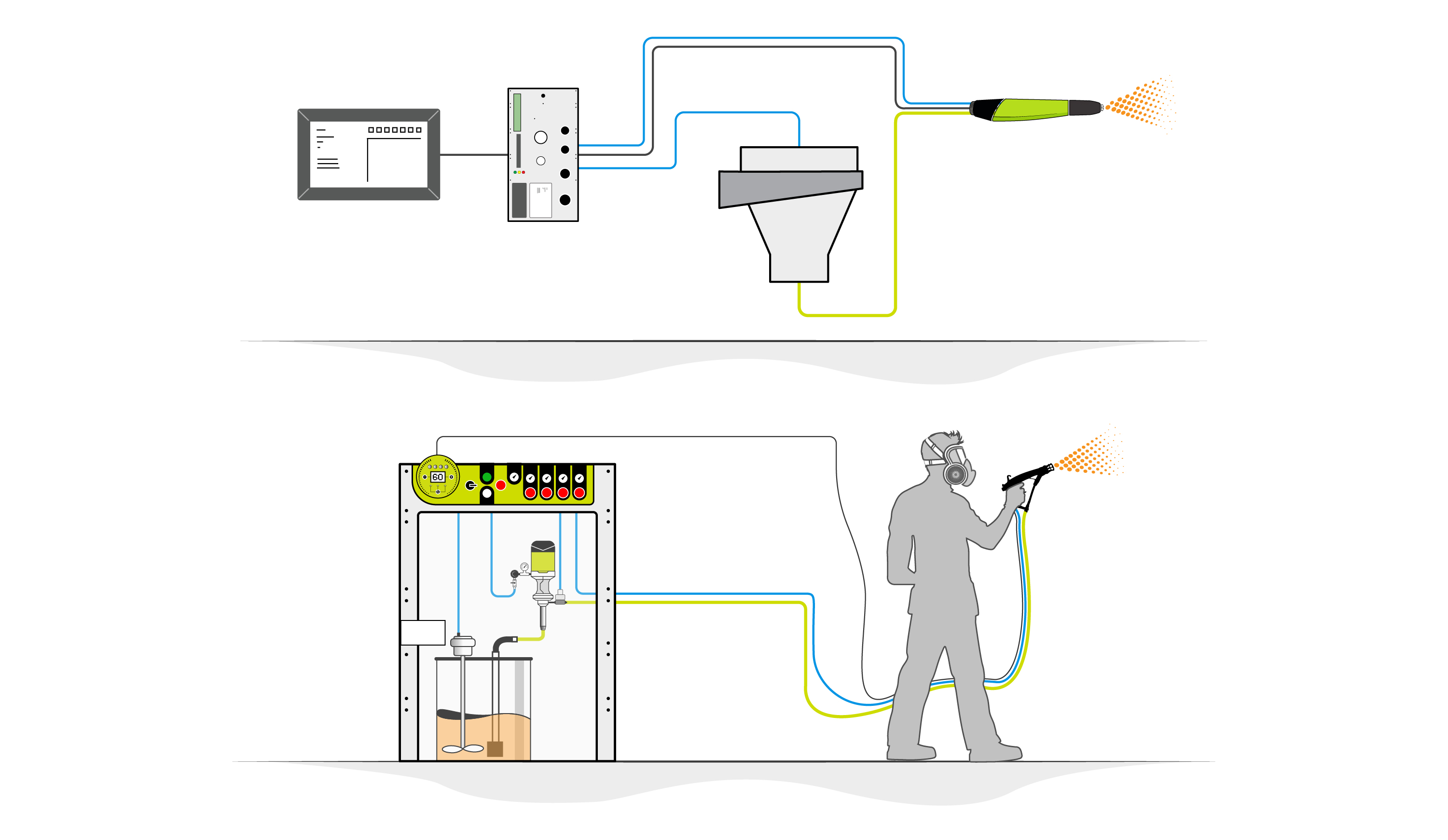






Unmatched Powder Precision: Our CSV230 pressurized pot ensures ultra-low and consistent powder flow, no puffing, no waste, perfect for developer application.
Exclusive Technology Advantage: Unlike competitors using Venturi systems, our powder delivery is smoother, cleaner, and more controllable a unique edge in the NDT market.
Cost-Effective Excellence: The Inocart NDT package delivers superior performance at a competitive price (~8,000€), offering both technical and financial benefits.
Electrostatic expertise across applications: From manual Nanogun to automated bells Nanobell, our electrostatic liquid sprayers guarantee uniform coverage and optimized penetrant usage.
To prevent cross-contamination during Dye Penetrant Testing, each type of penetrant, S1 (solvent-removable), S2 (water-washable), and S3 (post-emulsifiable), must be applied using a dedicated applicator. This is especially critical in aerospace and defense, where high-sensitivity inspections demand strict process control and the correct cleaning method for each penetrant type must be strictly followed.
Yes, while the standard Dye Penetrant Testing (DPT) process remains the most widely used, several alternative methods are emerging, particularly within the aerospace industry. Some advanced penetrants are now self-developing, eliminating the need for a separate developer step and simplifying the overall inspection process. In other cases, liquid developers are used instead of powder, and these often require continuous recirculation systems to ensure a uniform and effective coating.
To ensure optimal application of these newer penetrants and developers, some may require specific pumping technologies tailored to their viscosity or chemical nature. This emphasizes the importance of choosing the right equipment setup in addition to the right process.
Overall, the field of DPT is a highly diverse and technically nuanced domain. Describing it through a single, mainstream method can be reductive, as variations in materials, application needs, and inspection environments often require customized approaches. That’s why it’s always safer and more efficient to rely on an experienced partner like SAMES, who can provide tailored guidance, technical support, and equipment solutions adapted to your exact needs.
Yes, Sames spraying solutions are designed to be easily integrated into existing NDT installations. Whether your line is manual, semi-automatic, or fully automated, we offer modular equipment and adaptable technologies to suit your configuration. Our electrostatic guns, pressurized powder feed units, and automated applicators can be installed with minimal disruption, thanks to compact designs and user-friendly control systems. We also support integration through technical guidance, commissioning support, and training—ensuring a smooth transition and immediate performance benefits.
Yes, Sames spraying solutions are designed to be easily integrated into existing NDT installations. Whether your line is manual, semi-automatic, or fully automated, we offer modular equipment and adaptable technologies to suit your configuration.
Our electrostatic guns, pressurized powder feed units, and automated applicators can be installed with minimal disruption, thanks to compact designs and user-friendly control systems. We also support integration through technical guidance, commissioning support, and training ensuring a smooth transition and immediate performance benefits.