Gas tank and bottle
Let’s talk about your projectCoating gas tanks with electrostatic rotary-bell
Save up to 50% of paint, 30% of cycle time and obtain better finishing quality with Sames' Nanocoat robotic electrostatic rotary bell spraying.
Discover our solution
Gas cylinders are coated with liquid or powder paints, using manual or automatic application systems, to meet stringent environmental protection requirements while ensuring maximum productivity.
When coating is performed before valve assembly, powder coating is a viable option. However, when valves are already installed, or during bottle maintenance operations, liquid paint application is preferred.
These cylinders are typically color-coded, requiring fast and reliable multi-color coating systems, especially in automatic production lines.
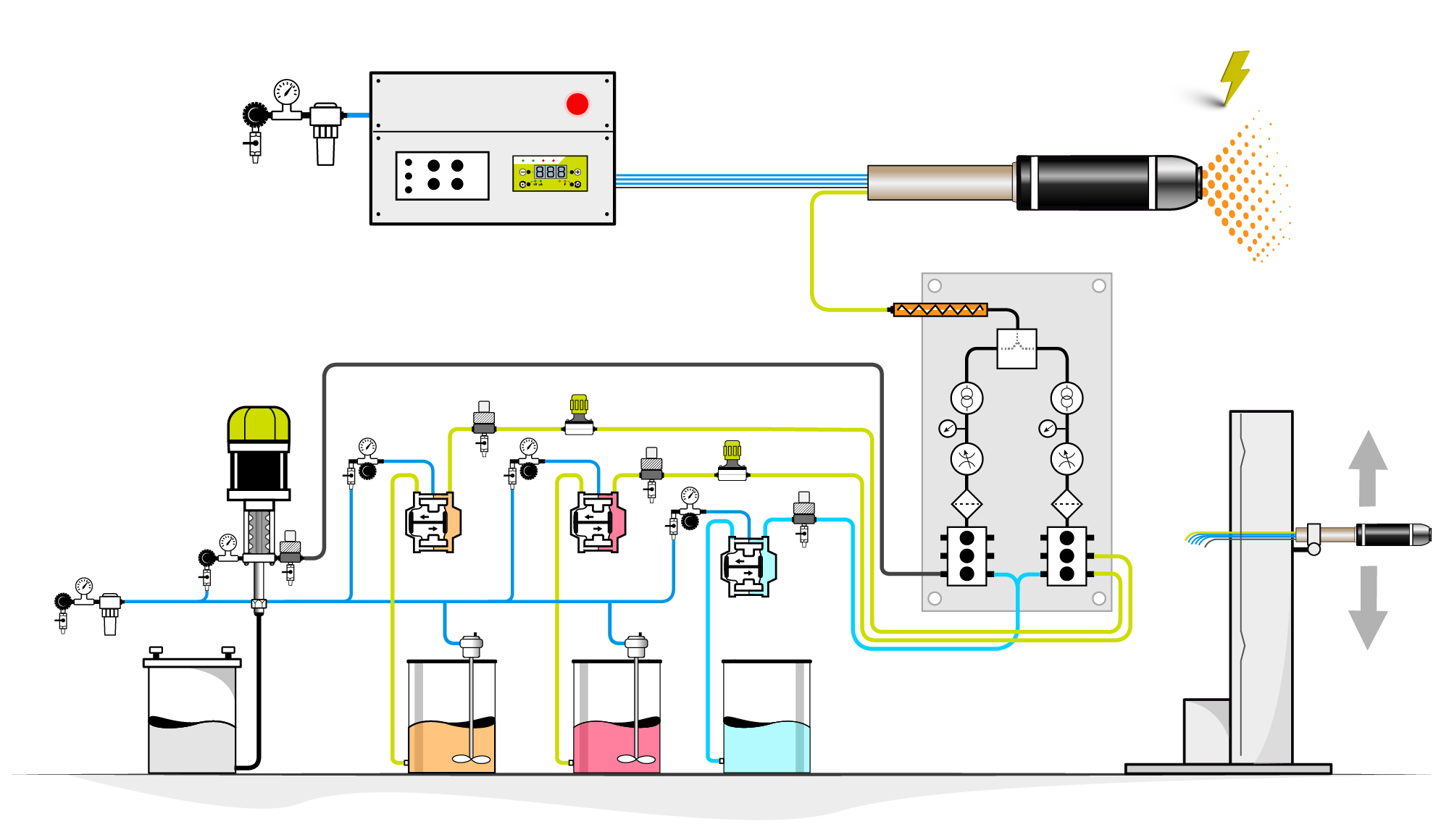
For operations demanding a high film build (80–120 µm) in a single pass, with fast color changes, high transfer efficiency, and high throughput, Sames recommends using a rotary electrostatic bell applicator with 2K paint systems.
In this configuration:
-
Bottles are transported via a stop-and-go conveyor, each rotating on itself for full surface coverage.
-
The bell sprayer is mounted on a reciprocator, enabling precise vertical motion.
-
Color change blocks are installed close to the bell, at the rear and midway height of the reciprocator, fed by a centralized paint kitchen, ensuring fast and clean transitions between colors.
-
Finally, a fixed Airspray gun applies the top color code marking in a wet-on-wet process for identification and compliance.
Interactive diagram for information purposes
Related products
Main benefits
Up to 50% higher transfer efficiency, thanks to the superior wraparound effect of the bell compared to a spray gun.
Increase productivity by up to 30%, thanks to the highest paint flow and maximum impact surface delivered by bells compared to spray guns.
Reduce paint consumption and minimize environmental contamination.
Gas tank and bottle Solution FAQ
Let's get in touch-
How can I achieve a two-tone coating?
Two-tone coating with precise separation between two colors is not achievable using a single reciprocating rotary bell, as its up-and-down movement and wide, diffused spray pattern are designed for uniform, continuous coverage—not for creating sharp transitions.To produce a clean and accurate two-tone effect, you need a setup with multiple fixed spray guns, each dedicated to a specific color. This allows for precise control of the spray area, enabling a sharp and well-defined transition between colors.While bell applicators are ideal for high-quality coverage and efficiency, their soft-edged spray pattern makes them unsuitable for sharply divided multi-color coatings. For two-tone applications, gun technologies are more appropriate. -
Why not choose powder coating for this application?
Powder coating is an excellent solution for durability and corrosion protection, but it requires high-temperature curing—typically above 180°C (356°F). When gas cylinders are already equipped with components like valve assemblies or sealing systems, exposing them to such heat can damage sensitive parts, making powder coating unsuitable after valve installation.Additionally, powder systems are not ideal for frequent color changes. In contrast, liquid coating solutions allow for faster, cleaner, and more flexible color changes, which is particularly important when dealing with color-coded cylinders or multi-color production lines.For applications requiring lower-temperature curing, operational flexibility, and quick color changes, liquid coating is the most practical and reliable solution. -
How difficult is it to operate a rotary bell compared to a spray gun?
It’s a common misconception that rotary bells are much more complex to operate than guns. In reality, a bell has just one more setting than an electrostatic gun: vortex air, straight air, turbine speed, paint flow, and high voltage — only five parameters to adjust instead of four. That’s a very small difference.In the specific case of gas cylinder coating, the bell operates with stable parameters throughout the production — no dynamic adjustments or complex robot trajectories. This makes setup and operation straightforward, even for teams used to spray guns.So yes, a bell is slightly more advanced, but in this context, it’s just a tiny step up — not the big leap the rumors suggest. -
Is this solution already implemented on an industrial scale?
Yes — and for a long time. This solution is already running successfully at multiple industrial sites, across various regions and major gas cylinder manufacturers. You can rely on our solid experience and proven performance. Just contact us — we’ll be glad to share references and support your project