
Hemming systems in Bodyshop

Let’s talk about your project

Robotic advanced solution for bonding inner and outer door panels, fronts, and tailgates

In car body construction, the bonding of the inner and outer panels of the doors, as well as the front and tailgate, represents a central process step. Dosing the right amount of adhesive ensures optimum sealing, reliable stability of the body, and the formation of a suitable substrate for the subsequent painting process.

Discover our solution

In the hemming bonding process, the inner and outer panels of the doors are joined with adhesive. In addition, the inner panel edge is flanged or folded through the outer panel at an angle of 180° to give the structure mechanical stability.

Two established techniques for applying adhesive are bead and swirl.

  • The bead method is particularly suitable for standard applications and is predominant in automotive plants.

  • The swirl method allows precise parameter control, but also requires additional proficiency.

In a standard double-drum system, two powerful ram stations pump highly viscous material from the container. The material then feeds a dosing unit mounted on a robot, which applies bead or swirl patterns to the sheet based on the selected application method.

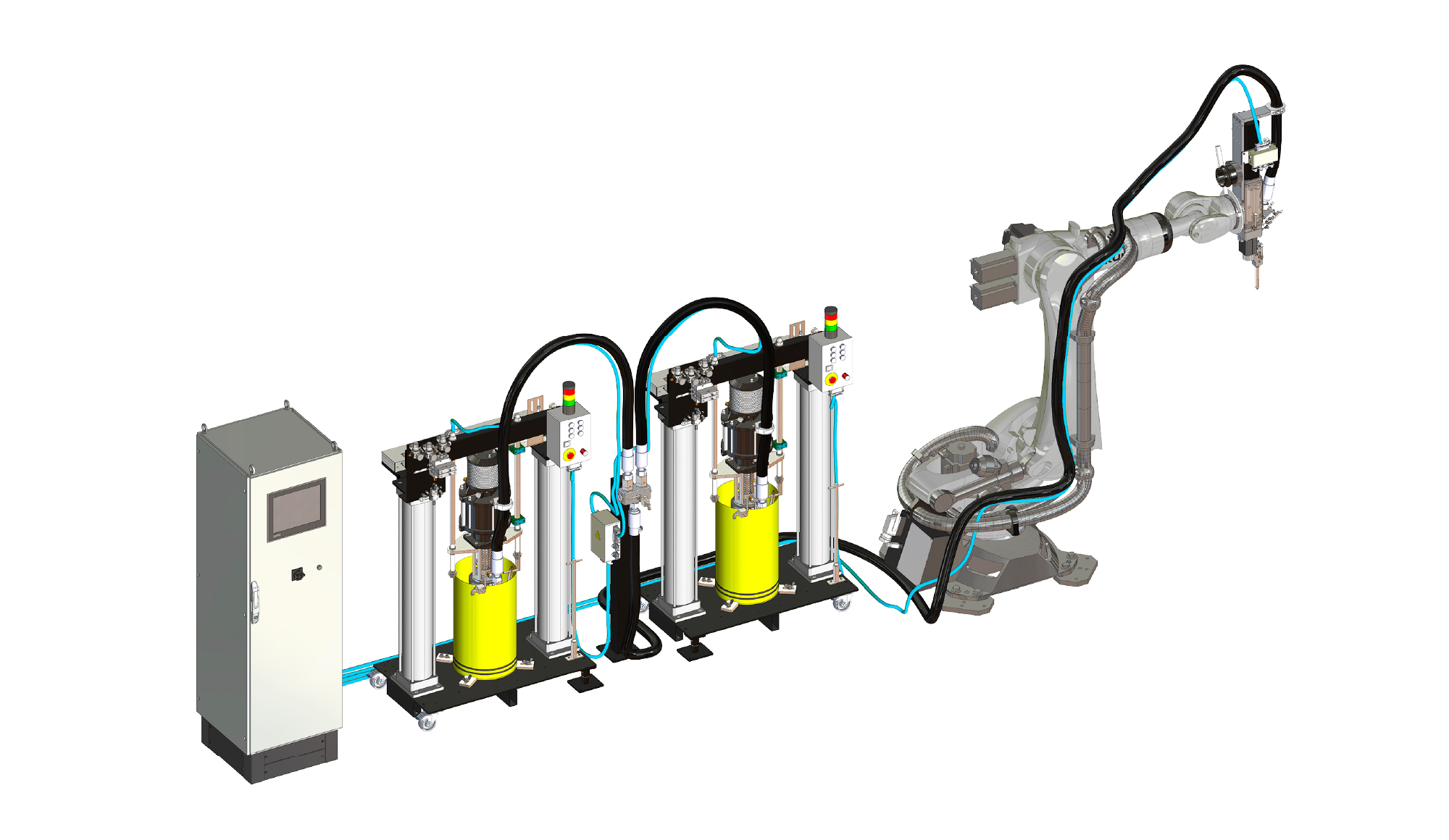
Interactive diagram for information purposes

Main benefits

Turnkey system from feeding to application

Secured process: 2D and 3D self-control camera system

Easy to maintain solution

Hemming systems in Bodyshop Solution FAQ

Contact us
  • Bead or Swirl application?

    In bead application, the nozzle-to-component distance is fixed, ensuring the bead cross-section remains constant.
    In swirl application, the distance is adjustable, allowing the adhesive width to vary. However, achieving even distribution requires an optimally set width.

    Conclusion:

    • In bead application, bead geometry depends on nozzle size and material flow.
    • In swirl application, adhesive width can be controlled by distance adjustment.
  • Why do I need a vision system?

    Efficient and reliable production is rounded off by a visual control system that monitors optimum adhesive application. Most plants already use 2D systems for this purpose. 3D monitoring systems are even more precise: They offer maximum process control but are more expensive to purchase.
    Conclusion: Visual monitoring of adhesive application is always worthwhile, regardless of whether a 2D or 3D system is used. Due to their geometry, beads are easier to monitor than swirls.
  • What impact does the choice of adhesive material have?

    Bead applications are predominant in the market because they can handle most adhesive types. Swirl applications, on the other hand, are not compatible with every adhesive as special fillers can cause the adhesive threads to break off. There is a risk of material being applied in the wrong place or of components, robots and grippers becoming contaminated by the uncontrolled tear-off thread of the adhesive. Similarly, deviations in material density per batch or per barrel lead to considerable problems in swirl application. Constant re-parameterization of the system would be the consequence, which would require additional costs and time. Likewise, the swirling of the material means that air and oil inclusions can occur after joining so that the overall quality of the application is reduced.
    Conclusion: Most types of adhesive, even those without high quality requirements are easiest to apply by bead or bead-on-bead. The swirl requires exact matching of the material to the production since density and temperature variations can directly affect the result and the quality of the bond.
  • What knowledge is required for operating hemming systems?

    Different technologies require different levels of technical knowledge and corresponding staff training. Bead application is particularly simple, as only the flow, speed, and temperature of the adhesive need to be set. Swirl application is more complex in comparison, as the distance to the component and the rotation speed (E-Swirl), or the air proportion (P-Swirl) must also be controlled. If a parameter changes, the entire system must be adjusted.
    Conclusion: Bead application requires a lower level of knowledge than swirl technology since fewer parameters have to be taken into account.

Still have questions?

Let’s talk - our experts are just a message away.

Let's get in touch