










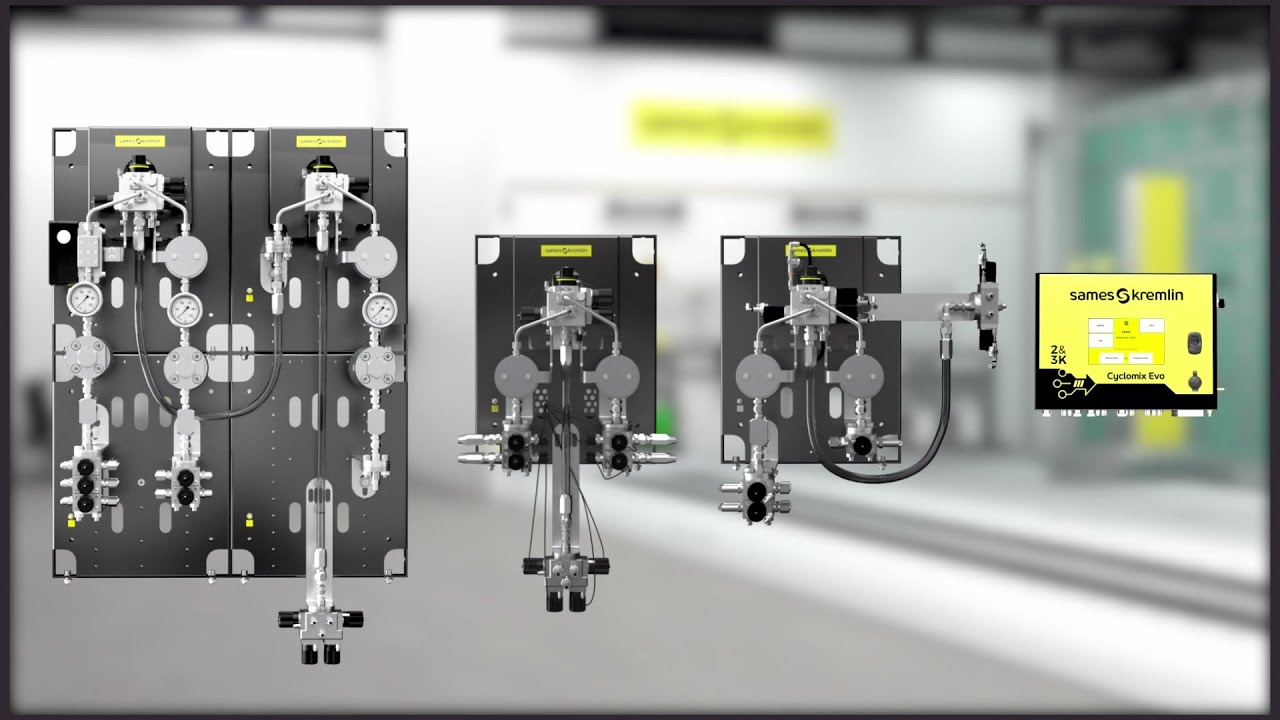


Sistema di Miscelazione & Dosaggio Elettronico - 2 o 3 Componenti - Airspray, Airmix®, Airless®
 Dosaggio e miscelazione perfetti
Gestione ottimizzata degli sprechi
Piena connettività
Dosaggio e miscelazione perfetti
Gestione ottimizzata degli sprechi
Piena connettività

1 Sistema di dosaggio brevettato: il catalizzatore viene polverizzato nella base
1 Frequenza di iniezione ultra veloce grazie alla nostra nuova valvola di iniezione
♦ Precisione di miscelazione +/- 1%.
2 Gestione di 2 circuiti indipendenti: lavaggio e carico colore separati su 2 circuiti
3 Possibilità di definire la propria configurazione da una versione base 2K a una versione full optional 3K
2 minuti di training per una rapida messa in servizio
♦ Acquista solo la configurazione necessaria. Senza acquistare funzioni inutili
♦ Aumentate la vostra capacità produttiva aggiungendo funzionalità durante la vita del Cyclomix® Evo
♦ Diagnostica e manutenzione a distanza per evitare tempi di inattività della produzione.
4 Riduzione dei costi e degli scarti di vernice miscelata grazie alla funzione "ottimizzazione della vernice".
5 Monitoraggio dei dati di produzione e manutenzione tramite smartphone
♦ Recupero dei dati di produzione e manutenzione per ottimizzare il vostro strumento di produzione
♦ Perfettamente adatto ai catalizzatori acidi: guarnizioni, materiale e filettature che soddisfano i vincoli dei prodotti acidi o basici.
| Descrizione | Valore |
|---|---|
| Pressione massima ingresso aria compressa (bar) | 6.5 |
| Pressione massima ingresso aria compressa (psi) | 87 |
| Pressione minima ingresso aria compressa (bar) | 4.5 |
| Pressione minima ingresso aria compressa (psi) | 58 |
| Intervallo di viscosità del materiale consigliato | 20 - 3000 in CA4 seconds (or centipoise cps) |
| Portata massima del fluido (cc/min) | 7000 |
| Portata massima del fluido (cfm) | 0.25 |
| Portata minima (cc/min) | 30 |
| Portata minima (oz/min) | 0.001 |
| Altezza (in) | 18.1 |
| Altezza (mm) | 46 |
| Larghezza/profondità (in) | 13.8 |
| Larghezza/profondità (mm) | 35 |
| Profondità (in) | 9.85 |
| Profondità (mm) | 25 |
| Pressione massima del prodotto (bar) | 240 |
| Pressione massima del prodotto (psi) | 3480 |
| Peso (kg) | 25 |
| Peso (lbs) | 55 |
| Numero di componenti (Max) | 99 |
| Numero di componenti A (Min/max) | 99 Min/Max |
| Numero di componenti B (Min/Max) | 99 Min/Max |
| Numero di componenti C (Min/Max) | 99 Min/Max |
| Numero di prodotti (base-catalizzatore-solvente) | 2K, 3K &(1K) base-catalyst-solvent |
| Precisione di miscelazione (%) | 1% |
| Rapporto di miscelazione | 100:1 à 1:2 (1% à 200%) |
| Tensione (V) | 230 |
| Porta di ingresso del prodotto | 1/2JIC or NPSM |
| Porta di uscita del prodotto | 1/2JIC or NPSM |
| Numero di pistole (max) | 2 |
| Parti a contatto con il prodotto | FFKM, PEEK, PTFE, Acciaio inox 303, Acciaio inox 316, Carburo di tungsteno |
| Passaggi del fluido | CTM 2MM INJECTOR STD 1MM |
| Certificazione | ATEX II (2) G Ex ia Gb IIB |
| Numero massimo di ricette | 250 |
| Descrizione | Codice |
|---|---|
| Quadro micro Cyclomix Evo | 155661890 |
| Flush box (FPro, FStart, Xcite®, SFlow®) | 155710000 |
| Descrizione | Codice |
|---|---|
| Miscelatore | 155660105 |
| Kit di alimentazione aria | 155661391 |
| Coperchio protettivo | 155661873 |
| Telaio per piastra prodotto tricomponente | 155661870 (x2) + 155661871 (x4) |
| Telaio per piastra prodotto bicomponente | 155661870 + 155661871 (x2) |
| Telaio per pannello di controllo | 155661872 |
| Flush box (FPro, FStart, Xcite®, SFlow®) | 155710000 |
| Kit per pilotaggio in cabina di verniciatura | 155661887 |
| Pannello di controllo a distanza | 155661880 |
| Flushbox Waste management | 155661700 |

An automatic spray gun is remotely operated, usually with compressed air. It ensures fast, consistent, and repeatable application, an essential advantage for automated production lines.
In contrast, a manual spray gun is handled directly by an operator. Its precision and flexibility make it an excellent choice for technical or complex tasks where human expertise makes a real difference.
Manual spray guns are ideal for small-scale projects, while automatic guns are better suited for production lines.
Our robotic spraying solutions ensure precise and consistent application with every cycle, minimizing the need for touch-ups and reducing material waste. Thanks to advanced robotic technology, your projects benefit from maximum consistency and efficiency, even with complex geometries.
Our sprayers are highly versatile and suitable for a wide range of protective and preservation uses. Whether it's maintaining headlight clarity, applying anti-scratch coatings on screens, adding antibacterial protection, or using micro-particle solutions, our equipment ensures even, effective coverage.
Designed with precision engineering, our manual spray guns provide exceptional control and flexibility, perfect for detailed, high-precision work. Their ergonomic design and reliability make them essential tools for achieving premium-quality finishes.
A paint pump is designed to deliver material from its drum to the application point while maintaining the ideal pressure for a consistent, high-quality result. It ensures a continuous flow, reduces product loss, and optimizes application performance, whether in manual or automatic use.
Each nozzle is engineered with a precise size, determining spray width and material flow rate. If you notice a less defined spray, increased paint usage, or changes in finish quality, it likely means the nozzle is worn. Replacing a worn nozzle helps maintain application quality and avoid unnecessary product waste.
The nozzle is a key component of any spray system. It defines the spray pattern, flow rate, and application accuracy. Depending on its size and angle, the nozzle adjusts the spray for different paint types and project needs, ensuring controlled, high-quality finishes. Choosing the right nozzle is essential for consistent performance, precision, and paint savings.
Using non-Sames parts voids the warranty. For optimal performance, we recommend using certified Sames components exclusively.
An accessory refers to any additional component that complements your spraying system or enhances its functionality. This can include nozzles, filters, fittings, extension arms, hoses, or fluid regulators.
Accessories allow you to adapt your equipment to specific application needs and improve efficiency, precision, or ergonomics.
In our context, “equipment” refers to the main devices used for product application, including spray guns, pumps, controllers, and complete application systems (manual, automatic, or robotic).
Equipment forms the core of the spraying process, while accessories are optional add-ons that enhance its performance or ease of use.

